
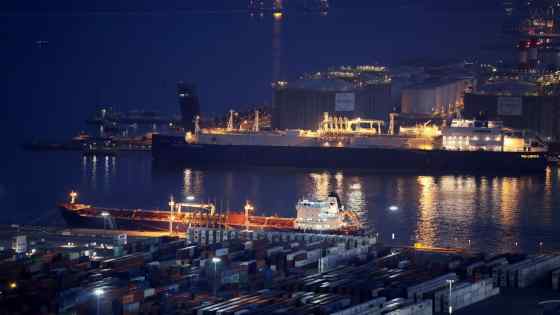


So, the leaked Chinese trade numbers turned out today to be dead right: despite the financial crisis in Europe, China’s largest market, exports in May rose by a staggering 48.5 per cent. While imports also rose 48 per cent, the impact of the export surge on the trade balance was dramatic – a surplus of $19.5bn.
The numbers are evidence of the strength of the Chinese economy (exports now are close to where they were before the global financial crisis of 2008-9) and are renewing speculation about possible moves by Beijing to revalue the renminbi.
But caution is in order: some companies may have pushed through exports in anticipation of a spring revaluation, which never came; also, if Europe’s financial upheavals now hit the real economy, the May export surge could prove short-lived. On balance, economists do not expect any dramatic Beijing currency moves – but there is a slim chance they might be wrong, as they were about the May trade numbers.
Geoff Dyer reports on ft.com that the strong increase in exports, which was much bigger than expected by analysts, meant that China’s $19.5bn May trade surplus was significantly larger than the $1.7bn surplus in April and the modest trade deficit in March.
Dyer writes:
The figures suggested that the economic problems in Europe, which is China’s largest export market, have yet to have any pronounced effect on demand for Chinese goods. However, economists cautioned that it could take several weeks before any difficulties in Europe would feed through to the trade numbers.
The government also said on Thursday that house prices rose 12.4 per cent in May year-on-year, down from a record increase of 12.8 per cent the month before. However, prices increased 0.2 per cent over the previous month, suggesting that the strict measures the government has introduced to cool the housing market, which have led to a sharp slowdown in the number of transactions, have yet to result in big price cuts.
Wengsheng Peng, economist at Barclays Capital in Hong Kong, told Reuters:
“This is a much stronger number than the market expected, particularly on the exports and the trade surplus side. This should help to reduce the recent bearish sentiment towards economic growth in China. Some investors in the market have become, in my view, too bearish.”
The Barclays economist added:
Reform of the exchange rate regime to increase flexibility remains an important policy objective, but that reform is indeed more about flexibility than appreciation. Any appreciation will be very moderate and gradual over time. Reform will be more about increasing two-way variations in the exchange rate.
Hao Daming, of Galaxy Securities, Beijing, says:
[The trade report] is a big surprise. The reason for such a huge increase is probably the low base last year. But the rapid pace is set to slow in the second half. As for the impact on a possible yuan revaluation, we think it will still be a few months before a conclusion is reached.
Asian markets have generally been quiet today, with the Shanghai Composite closing down 0.82 per cent, the Hang Seng up 0.31 per cent in late trading, and the Mumbai Sensex up 0.68 per cent.


Stefan Wagstyl
Josh Noble
Rob Minto
Pan Kwan Yuk
Jonathan Wheatley