So much for the US and China having patched up relations – the Communist Party’s mouthpiece has just slammed the US in an editorial.
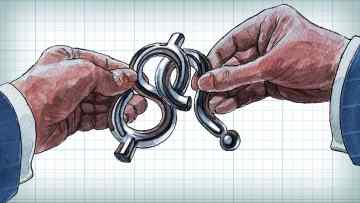
“Is the US ready for China’s ascent as a great power?” the People’s Daily asked on Thursday, warning that the two countries are on collision course if Uncle Sam doesn’t give way.
2010 got off a bad start for bilateral relations, with a dispute over American arms sales to Taiwan. Then came the Google standoff, followed by wider complaints that Beijing discriminates against foreign technology suppliers when awarding public procurement contracts.
As a result, Washington and Beijing both made an effort, and calm seemed to have been restored. But, if the People’s Daily is to be believed, there are more squabbles to come.
According to its editorial:
[Despite increasing dialogue] some deep-seated structural contradictions in the Chinese-American relationship have not been softened. On the contrary, in the process of close contact, the collision of interests between the two sides could increase.
Some less hawkish observers have expressed surprise. “I’m puzzled by the tough tone,” says Teng Jianqun, a military expert at the China Institute of International Studies in Beijing. ”
However, the People’s Daily editorial is no outlier. It caps a week of rants from Chinese government officials, military officers and state media, after Hillary Clinton last week identified stability in the South China Sea as a US national interest.
Clinton called for regional dialogue about tension in the South China Sea, but a joint manoeuvre by US and South Korean troops, intended as a warning to North Korea, was furiously denounced as hostile by China.
The People’s Daily makes clear that this is not just about military and regional security issues:
Arms sales to Taiwan, the Google incident, manipulation of the Renminbi valuation issue, spreading the theory that China was responsible for the financial crisis …. Washington has by no means clarified its thinking and calmed down its feelings about how to deal with a rapidly developing China.
It moved on to reject the expectation that China would become more tolerant with growing global influence: “When it comes to our national interests, China has no room to manoevre.”
That’s not what the Obama administration had hoped to hear.
Related reading:
Why Taiwanese companies are latecomers to China, beyondbrics
US wary of upsetting its new friend, FT.com


Stefan Wagstyl
Josh Noble
Rob Minto
Pan Kwan Yuk
Jonathan Wheatley