Romania’s prime minister Emil Boc resigned on Monday, becoming the latest European Union political leader to fall victim to economic crisis – and the first in eastern Europe.
But although the news came as a surprise it brought remarkably little market reaction, with the leu holding steady and Romanian stocks falling only 1.7 per cent.
So, Boc may look like a leader hurriedly abandoning office in the face of public protest. But his departure could well turn out to be a desperate political manoeuvre orchestrated by his chief backer, president Traian Basescu (pictured).
Boc said in a televised speech he was leaving because of the tensions generated in recent weeks by repeated demonstrations against the economic austerity programme implemented by his government at the behest of the EU and the IMF.
“I took this decision to release the tension in the country’s political and social situation, but also in order not to lose what Romanians have won,” Boc said, according to Reuters.
Basescu named Boc’s justice minister, Catalin Predoiu, as the interim new prime minister.
[Update] Later in the day, Basescu nominated Mihai Razvan Ungureanu, the head of the foreign intelligence service, as the country’s new prime minister, asking him to form a government that would takeover from Prediou’s interim administration. As a non-party man he is hardly likely to emerge as a powerful new leader able to rebuild the ruling liberal coalition’s failing public support, let alone to force through any radical policy changes. [Update ends]
The Fund quickly moved to reassure investors that Bucharest’s €5bn precautionary financing programme, together with the public spending cuts that go with it, remained in place.
IMF/EU officials said in a statement in Brussels:
All IMF quantitative performance criteria for end-December were met. The authorities have made good progress in implementing program policies in a very difficult external environment.
So what’s going on?
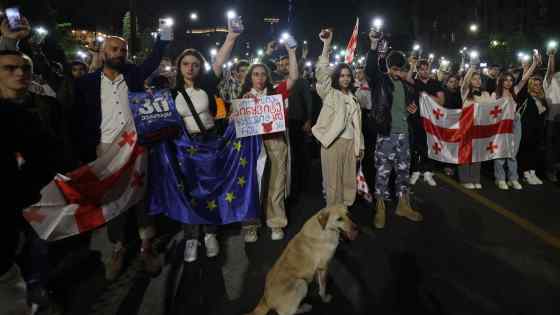
The anti-government rallies are not to be underestimated, with thousands braving sub-zero temperatures. What began as a protest against the departure of a popular health official (who was subsequently reinstated) has mushroomed into a wide-ranging anti-government campaign, supported by the opposition leftist USL.
With only 20 per cent support, Boc’s centrist PDL has so far battled successfully to hold together a fragile coalition with the backing of the ethnic Hungarian UMDR and some independents.
But the demonstrations don’t seem big enough, in themselves, to have forced the prime minister’s hand. Bucharest saw much larger – and more violent – gatherings in the 1990s.
What’s more likely is that, with local elections due in the early summer and parliamentary polls in November, coalition politicians are beginning to look to their constituencies and worry about the political price they could pay for backing unpopular reforms.
Any hope that the economy might recover this year – after a steep recession in 2009 and a feeble pick-up in activity since – has been dashed by the latest forecasts, which see GDP growing by under 1 per cent.
So it’s no surprise that the coalition is starting to wobble, especially as the Hungarian party has a history of joining coalitions of both the left and the right, siding with election winners.
With the USL now running at above 50 per cent in the polls, it is easy to see which way the wind is blowing.
It could be that Boc is leaving simply because he’s had enough. But it is more likely that he and Basescu are looking to regroup their forces in advance of the elections. The new prime minister might be able to put some distance between himself and the austerity programme. Even if the programme doesn’t change, he could at blame his predecessor.
The switch will also allow Basescu to show that he is responding to public opinion. Even though he has been a forthright backer of the Boc government, he is a populist unlikely to underestimate the importance of winning elections.
At the very least, he can play for time: a new government will have up to 60 days to obtain a parliamentary vote of confidence. It it fails, an early election can be called. That might not suit Basescu’s allies right now, but they can hope that something turns up.
Simon Quiano-Evans, a strategist at ING Bank, wrote in a note:
The resignation of PM Boc is a surprise ahead of the planned autumn parliamentary elections, and again another of the spillover effects of weakness in the Eurozone from: 1) the growth side, 2) the high exposure to FX loans, and 3) the huge hit that the “convergence story” has taken from the noise out of the Eurozone
Today’s move by the PM should be seen more as a sign of desperation, given the strong pressure on the government to cede to protests over the last few weeks, versus the stark position of the EU/IMF on issues such as public sector wages and pensions
Indeed, the political backdrop risks pushing the country back into the uncertainty of a few years ago, where political parties failed to reach a consensus agreement to put the country back on a growth path, in turn leaving the sovereign ratings open to downgrades – a clear risk for a cut in the outlook [in the short-term].
None of this is great for the economic outlook for Romania. Investors prefer stability. They don’t like surprise resignations from market-friendly prime ministers. But when it comes to striking a balance between the markets and public opinion, EU leaders face some difficult choices. President Basescu so far has managed the post-2008 crisis much better than was expected. It would be rash to bet against him now.
Related reading:
Romania: staying ahead on rate cuts, beyondbrics
Romania: Boc – snowed under, beyondbrics
East Europe at mercy of deleveraging west, Neil Buckley, FT
Banking: walking away, FT
Special Report: Investing in central and eastern Europe, FT


Stefan Wagstyl
Josh Noble
Rob Minto
Pan Kwan Yuk
Jonathan Wheatley