



India’s government painted a rosy picture of the economy on Wednesday, when the prime minister’s economic advisory council released its economic review for the fiscal year ending in March. But a shortage of investment casts doubt over its optimism.
Projected GDP growth has been revised up from 6.9 per cent to 7.1 per cent. Next year, the council said the economy would grow by 7.5 per cent to 8 per cent, helped by lower inflation – seen falling from near double digits for most of 2011 to between 5 per cent and 6 per cent for the coming fiscal year.
But economists said figures for gross fixed capital formation suggested a bleaker outlook: India is investing far too little, threatening both near-term and longer-term growth.
“The growth forecasts are too optimistic and actually it is also too optimistic on inflation – but they’re part of the government so you’d expect that,” A Prasanna, economist at ICICI Securities, told beyondbrics. “[GFCF] captures… basically that [companies are] not investing at the same rate at which the economy is growing. Ideally, you’d want them to invest at a faster rate because India needs more investment.”
GFCF as a proportion of GDP peaked at 32.9 per cent in the year ending March 2008 but declined steadily to 30.4 per cent for the year ending March 2011. In the current fiscal year the figure is set to slip even further, to 29.3 per cent.
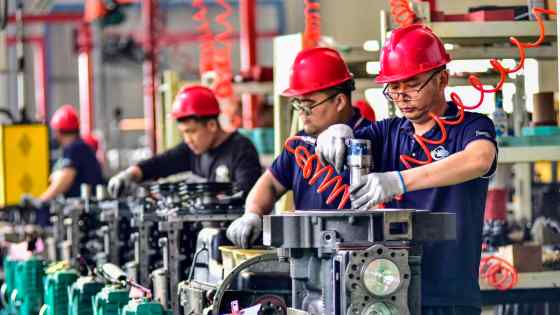
In China, by comparison, investment measured by GFCF is 46 per cent of GDP, up from 28 per cent in 1980 (and, even so, some economists say it is still investing too little). So it should be no surprise that China’s infrastructure and economic development far outstrip India’s.
India’s investment ratio, meanwhile, has fallen due to a number of factors, including high interest rates, bureaucracy and a lack of regulatory and policy certainty.
“Red tape is a catch-all phrase – in India it’s specifically related to environmental clearances and land acquisition, which are ongoing and the government is supposed to be sorting it out, but there hasn’t been much movement,” said Prasanna.
That kind of inaction on the part of the government has made companies more wary of investing. Chinese companies tend not to have such concerns.
“In China there is a relentless focus on investment, and it is driven by the government’s policy framework and how local bodies encourage – it’s a top down focus on investment,” Prasanna said. “That kind of seriousness of how they approach it is not comparable [to India] at all.”
The Congress Party-led administration often seems more interested in politics than government, and with local elections going on in India’s biggest state and national elections set for 2014, few expect this to get change any time soon. That doesn’t bode well for India’s growth story.
“One of the things to understand is that this will obviously not just impact the current year’s growth – if investment is slowing down then it will impact potential growth down the line as well,” Prasanna said. “So that is the reason that it is worrisome if every year it is coming down.”
Related reading:
India economy: turning the corner? beyondbrics
Life in Mumbai: blackouts, floods, deadly disease and other opportunities, beyondbrics
India: Tata dispute highlights case for land reform, beyondbrics


Stefan Wagstyl
Josh Noble
Rob Minto
Pan Kwan Yuk
Jonathan Wheatley