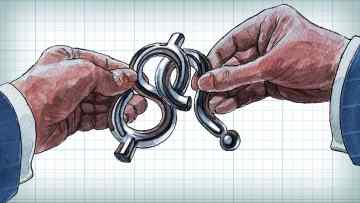
Farewell to Brussels

For better or worse, my time is up as Brussels bureau chief for the Financial Times, so this is my last post on this blog.  My successor, Peter Spiegel, will arrive in September.  I wish him, and all the readers and contributors to the Brussels Blog, the very best.

Leaving Brussels after three years feels rather like exiting an intensely gripping drama at the end of Act III instead of staying to the end.  The fate of Polonius in Hamlet comes to mind.  What was his sententious advice to his son?  ”Neither a borrower nor a lender be/ For loan oft loses both itself and friend/ And borrowing dulls the edge of husbandry.”  Now there’s something for Angela Merkel and George Papandreou to chew on.

In Brussels there are days when you feel the European Union is a magnificent creation, one of the most inspired experiments in mankind’s history.  Then there are days when you feel disgusted by the pettiness, the short-sightedness, the incoherence of it all.  As followers of this blog will know, I count myself a European in heart and soul and I desperately want the EU to succeed.

But there is no point in denying that the EU has lost its way in recent years.  I don’t just mean in an economic sense, though Europe’s relatively weak economic performance and the crisis in the EU’s public finances speak for themselves.  It has also lost its way in terms of its ability to act as a powerful, usually benign influence in world affairs.  And, sadly, it has lost its way in terms of democracy and accountability – the very values of public life where it could and should be a beacon to the world.

These are the three areas where the EU has to make a big effort in the coming years.  It must demonstrate that it can indeed liven up its economic performance and reverse what is beginning to look like an irreversible decline into late middle-aged infirmity.  It must show that it can be an effective force for stability and prosperity in its immediate neighbourhood, especially countries such as Bosnia-Herzegovina, Ukraine and Turkey. This matters far more than all the dreams about global power projection.  And the EU really must do something about the so-called “democratic deficit” – the alarming gap between the EU institutions and European citizens.  This problem is, quite frankly, reaching embarrassing proportions.

If the EU fails to make progress on these three fronts, there is a risk that it will sooner or later face a crisis of legitimacy that will be even more serious than this year’s sovereign debt troubles. No one in Europe should wish for this.  In spite of all its faults, the EU has immense achievements to its credit and we Europeans have a lot to thank it for.  But the time for delaying, squabbling and pretending the problems are not that serious after all is over.  From the bottom of my heart I hope Europe’s leaders get it right.

Brussels blog

Notes from the EU

About this blog Blog guide
This blog covers everything from the European Union's foreign and economic policies to the fortunes of its political leaders - as well as the more light-hearted aspects of life in Europe.


To comment, please register for free with FT.com and read our policy on submitting comments.

All posts are published in UK time.

Contact the Brussels blog team: Peter Spiegel, Joshua Chaffin, Alex Barker and Stanley Pignal.

See the full list of FT blogs.

The Brussels blog authors

Peter Spiegel is the FT's Brussels bureau chief. He returned to the FT in August 2010 after spending five years covering foreign policy and national security issues from Washington for the Wall Street Journal and the Los Angeles Times, focusing on the wars in Iraq and Afghanistan. He first joined the FT in 1999 covering business regulation and corporate crime in its Washington bureau, before spending four years covering military affairs and the defence industry in London and Washington.

Joshua Chaffin is one of the FT's EU correspondents, covering areas including policies on trade, the environment and energy. He has worked in the FT's Brussels bureau since late 2008 and before that was an FT correspondent in New York and Washington DC.

Alex Barker is EU correspondent, covering the single market, financial regulation and competition. He was formerly an FT political correspondent in the UK and joined the FT in 2005.

Stanley Pignal is Brussels correspondent for the Financial Times, covering EU justice, home affairs, social developments, telecoms and the Benelux region. He joined the bureau in January 2009, having previously worked for the FT as a corporate reporter in London.

FT blog: The World

Across the globe: Gideon Rachman and his FT colleagues debate international affairs on The World blog.

In the news

Angela Merkel Belgium Budget credit ratings agencies EU presidency EU summits European banks European Central Bank eurozone Finland Germany Greece Herman Van Rompuy Hungary IMF Italy Jose Manuel Barroso Libya Mario Monti Michel Barnier Nato Nicolas Sarkozy Olli Rehn Portugal Schengen Silvio Berlusconi sovereign debt crisis Spain Viktor Orban

Archive

« Jun Aug »July 2010
M T W T F S S
 1234
567891011
12131415161718
19202122232425
262728293031