The dilemma for the dollar

November 13th, 2009 12:23pm

By Paul De Grauwe

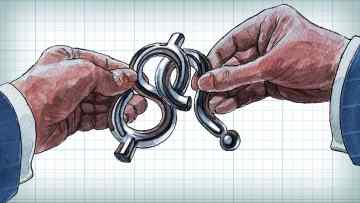
The recent decline of the dollar against major currencies such as the euro and the Japanese yen has been spectacular. Even more spectacular, but often forgotten, is the long run decline of the dollar against the major currencies in the world. Since 1960 the dollar lost two thirds of its value against the Japanese yen, the Swiss franc and the German mark (since 1999 the euro).

The long-term decline of the dollar appears to be quite surprising especially considering that at least since the early 1990s the US has been seen to produce superior economic results, ie a higher productivity growth than most of Europe and Japan with more or less the same rates of inflation. Yet despite the appearance of superior economic performance the dollar has gone on losing value against currencies of countries deemed to have an inferior economic system. Where does this paradox come from? Continue reading "The dilemma for the dollar"

Further Reading

October 5th, 2009 12:48pm

From the FT:

Michael Milken: Prosperity rests on human and social capital

Wolfgang Münchau: Diverging deficits could fracture the eurozone

John Authers: Crisis creates new sophistication in risk

Deven Sharma: Insight: Consistency in credit ratings

Elsewhere:

Dimitri Vayanos and Paul Woolley, VOX EU: Capital market theory after the efficient market hypothesis

Simon Johnson, Peterson Institute: The G-20, the IMF, and Legitimacy

Paul Krugman, NYT: Obama’s Anzio

James Kwak, The Baseline Scenario: Fed Chest-Thumping for Beginners

Another crash is all too possible

September 30th, 2009 4:20pm

By Michael Pomerleano

I was in Chicago last week to participate in the 12th Annual International Banking Conference sponsored by the Federal Reserve Bank of Chicago and the World Bank. The answer to the question posed — have the rules of the global financial game really changed? — is a resounding no.

This was my first week back in the US after being away for three years, and the conference gave me an opportunity to gauge the state of the debate there. Compared to my two years at the Bank of International Settlements in Basel and my year at the Bank of Israel, the openness of the debate and the quality of the discussions in Chicago were refreshing. However, in the US — the epicentre of the crisis and the country that is supposed to lead the world toward reform and out of the crisis — I expected a far more forceful articulation of remedial measures. Continue reading "Another crash is all too possible"

Further reading

September 4th, 2009 12:12pm

From the FT:

Jean-Claude Trichet: Europe has mapped its monetary exit

Timothy Geithner: Financial stability depends on more capital

Gillian Tett: A matter of retribution

Elsewhere:

Mark Kleinman: Reforming regulatory benefit cost analysis

Viral Acharya:   Systemic risk and deposit insurance premiums

Paul Krugman:  How did economists get it so wrong?

How the EU could stop the global crisis becoming a European problem

August 23rd, 2009 1:58pm

By Andre Sapir

Imagine the US was facing the current crisis with the following situation: only 30 of its 50 states belong to the dollar area; most of the southern states are outside the dollar area and so is New York, home of the US financial centre; the seat of the US government is in Washington, but dollar area chairman Ben Bernanke operates from Pittsburgh and secretary Tim Geithner is mainly governor of Vermont, one of the smallest US states, with a population of roughly half a million.

Absurd? Yet this is exactly what the European Union looks like, with only 16 of its 27 member states belonging to the euro area; most of the eastern states and the UK, home of the EU financial centre, outside the euro area; the seat of the EU institutions in Brussels, but ECB president Jean-Claude Trichet operating from Frankfurt and Eurogroup chairman Jean-Claude Juncker mainly the prime minister of Luxembourg. Continue reading "How the EU could stop the global crisis becoming a European problem"

Further reading

August 14th, 2009 11:52am

From the FT:

Data raise hopes for eurozone recovery France and Germany return to growth

How to release the next boom New growth drivers will emerge, says George Magnus

Elsewhere:

Debtor’s revolt A widespread debt revulsion? Naked Capitalism

When insolvent banks are worth billions We’re nowhere near the point at which you can judge the health of a bank by looking at its share price Felix Salmon

China rising, Rent-seeking version The reason to worry about China  has  little to do with external balances.  It’s about productivity and rent-seeking The Baseline Scenario

Feeble domestic demand is a chronic European ailment

May 27th, 2009 1:44am

Ingram Pinn illustration

Why has the European Union suffered so badly in a crisis that began in the US? The answer is to be found in four weaknesses: first, Germany, the EU’s biggest economy, is heavily dependent on foreign spending; second, several western European economies are suffering from post-bubble collapses in demand; third, parts of central and eastern Europe are also being forced to cut spending; and, fourth, European banks proved vulnerable to both the US crisis and to difficulties nearer home. Given these realities, recovery is likely to be slow and painful. Continue reading "Feeble domestic demand is a chronic European ailment"

Is the UK once again the economic sick man?

April 24th, 2009 1:21am

Is the UK once again the economic sick man? Or is it, as Alistair Darling, chancellor of the exchequer, argued in his Budget speech on Wednesday, just one of a number of hard-hit high-income countries? The answers to these questions are: yes and yes. The explanation for this ambiguity is that the fiscal deterioration is extraordinary, but the economic collapse is not. Continue reading "Is the UK once again the economic sick man?"

The de Larosière report: two down, two to go

March 13th, 2009 1:16pm

By Charles Goodhart and Dirk Schoenmaker

The recent de Larosière report on financial supervision and stability in the European Union should be praised for its rigorous assessment of the shortcomings of the current, mainly national-based regulatory system. It also makes some recommendations to resolve these shortcomings.

First, the report recommends the introduction of macro-prudential supervision. The financial crisis has illustrated that the micro-focus of supervisors on individual institutions does not suffice. This micro-focus
should be supplemented by a macro-approach to detect the development of imbalances in the financial system, such as excessive capital growth. Continue reading "The de Larosière report: two down, two to go"

The eurozone depends on a strong US recovery

December 10th, 2008 1:21am

I think of it as an “oops” moment: the US goes into a recession; Europeans believe this deserved punishment has little to do with them; the European economy slows unexpectedly; the US throws everything at restoring growth; finally, the US recovers, pulling Europe behind it.

Yet this is not just a slow-down. It is also a financial crisis. What if the solvency of a eurozone member came into doubt? After all, spreads over rates on German bunds and the prices of credit default swaps have risen already, the most affected countries being Belgium, Greece, Ireland, Italy, Portugal and Spain (see charts).

Eurozone members are like local governments. If they were unable to refinance their debt, they would be forced to default or need outside rescue. True, even the Greek spread of 165 basis points does not imply a high probability of default. The actual rate of interest – 4.7 per cent – is not unmanageable either. Yet markets can shift at great speed. It is possible to imagine a “sudden stop” on higher-risk sovereign bonds. That would force the debt to become short term – a classic route to a crisis.

The remainder of the article can be read here. Discussion from our forum members and contributors appears below