Smart bomb or damp squib in the oil market?

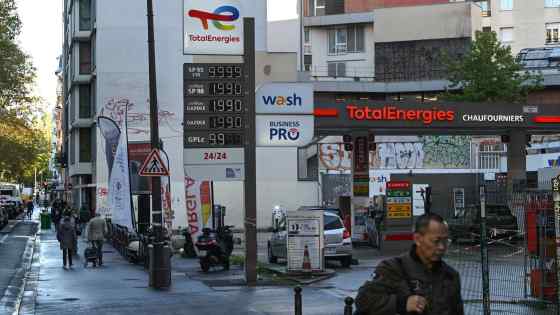
By far the most important event in the financial markets this week was the unexpected release of oil stocks by the IEA, which almost immediately reduced the global oil price by about 8 per cent. The motivation for this intervention might well have been Washington politics but, if the fall in the oil price persists, it will have a very useful effect on global economic activity, just when it is most needed.

Former US vice president Dick Cheney used to describe the release of oil stocks by the IEA as a “nuclear option”, which could almost never be used. The FT’s commodities editor Javier Blas says that it is now viewed as a “smart bomb” aimed mainly at oil speculators. But others, including this FT editorial, see the IEA’s tactics as pointless or self-destructive. So is it just a damp squib?

The IEA’s use of direct intervention in the oil market can be compared with intervention by central banks to affect the direction of foreign exchange rates. After many years of debate, central banks now believe that foreign exchange intervention is most likely to work when it is aimed at reinforcing the direction of the fundamentals in the currency market, especially when temporary bouts of speculation are driving exchange rates away from these fundamentals.

Sudden central bank “raids” on speculative activity, especially when the market is over-stretched, can drive currencies more rapidly towards “equilibrium”, or so it is claimed. By contrast, intervention is unlikely to be successful if it is intended to prevent a change in a currency which is driven by fundamentals, and certainly not when this intervention is limited by a potential shortage of f/x reserves at the intervening central bank.

Using this analogy, how does the IEA’s action stack up? Until recently, the established opinion of macro-economists has been that speculation can only impact oil prices if it affects inventory holdings (since speculators can logically have no effect on total oil demand unless they are willing to hold physical oil). More recently, this conclusion has been questioned. It has been pointed out that oil producers can engage in “speculation” by withholding supply from the market when they expect prices to rise. When this happens, “inventories in the ground” increase, and prices rise.

Although none of this explains the oil price rises from 2002-08 (when global demand increases, driven by emerging market GDP growth, were by far the dominant factor), speculation does seem to have impacted the scale of the massive oil spikes in 1979, 1986 and 1990. (See this study.) Since two of these oil spikes played key roles in triggering global recessions, the IEA is clearly justified in attempting to prevent such events from repeating themselves.

In an earlier blog on fundamentals and speculation in the oil market, I suggested that the rise in prices in 2011 may not have been fully justified by the loss of Libyan oil supplies, and the underlying growth of global demand. This leaves room for speculative effects, either in the financial markets or among physical oil traders. This suggestion was supported last week by an important CEPR paper on the oil price by Christiane Baumeister and Lutz Kilian, which presents structural VAR models of the oil market. These models enable the authors both to forecast the oil price more successfully than the futures market, and to estimate what determining factors have driven oil price changes in the past.

The conclusion of this work, based on information up to the end of 2010, is that the oil price should drop to around $75/ barrel by the end of 2012. The loss of Libyan supply should have temporarily increased the global oil price by around 7 per cent, which implies that “the sustained rise in the real price of oil since February 2011 cannot be attributed to the oil supply disruption alone.”

Using the Gulf War experience of 1990/91 as a guide, the authors reckon that speculative or precautionary demand for oil in early 2011 might have increased the real price by about 19 per cent, and they conclude that the $114 /barrel price for WTI in April was “consistent with even stronger speculative demand pressures than in 1990, especially considering the slowdown in global economic activity in early 2011″. (Note that this does not automatically imply financial market speculation; since changes in the physical supply and demand for oil are required to change the spot price, it is more likely to involve short term changes in  behaviour by physical operators like producers and ultimate oil users.)

If this econometric work is accurate (and it is the best I have seen on the subject so far), it suggests that speculative or precautionary forces were at work in increasing oil prices in recent months, and also that economic fundamentals should be depressing the oil price in the next year or so as the growth in global industrial production slows.  Taking the earlier analogy with currency intervention a step further, it would imply that conditions in the oil market were ripe for a temporary bout of intervention by the IEA.

If attempted repeatedly, the IEA would of course run out of reserves, just like a central bank, and the tactic could seriously backfire. But last week’s action was well timed and so far it has shifted the world economy in the right direction. Sometimes, politics and economics can (fortuitously) point in the same direction.

Gavyn Davies

on macroeconomics

About this blog About Gavyn Blog guide
A blog on macroeconomics, economic policymaking and the financial markets. Gavyn usually writes about a key topic of the week on Sunday.

Follow Gavyn Davies on the A-List.


Gavyn Davies is a macroeconomist who is now chairman of Fulcrum Asset Management and co-founder of Prisma Capital Partners. He was the head of the global economics department at Goldman Sachs from 1987-2001, and was chairman of the BBC from 2001-2004.

He has also served as an economic policy adviser in No 10 Downing Street, an external adviser to the British Treasury, and as a visiting professor at the London School of Economics.

Gavyn Davies is an active investor and may have financial interests and holdings in any of the topics about which he writes. The views expressed are solely those of Mr Davies and in no way reflect the views of Prisma Capital Partners LP, Fulcrum Asset Management LLP, their respective affiliates or representatives. This material is not intended to provide, and should not be relied upon for, investment advice or recommendations. Readers are urged to seek professional advice before making any investments.

To comment, please register for free with FT.com and read our policy on submitting comments.

All posts are published in UK time.

See the full list of FT blogs.

Archive

« May Jul »June 2011
M T W T F S S
 12345
6789101112
13141516171819
20212223242526
27282930  

Elsewhere on ft.com

Money Supply

Opinions on central banks around the world

Martin Wolf's Forum

Posts on economics from guest contributors