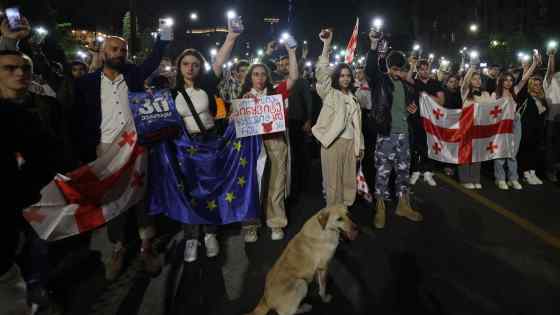

Well, Kosovo has been independent for about 24 hours, and so far things are going more or less as the British and Americans anticipated. The assumption was that there would be trouble within Kosovo itself - and violent protests in Serbia. But that Russia would restrict itself to diplomatic protests and would not escalate matters by recognising would-be statelets that want to break away from Georgia, like South Ossetia or Abkhazia. So far, that’s more or less how things are working out.
But unhappiness about the new state-of-affairs is not confined to the Balkans or Russia. As the FT reports this morning, there are several European Union countries that are refusing to recognise Kosovo - foremost among them Spain, which is worried about the implications for Basque separatism. The whole situation is a reminder that “European unity” can quickly shatter, when EU members feel that their basic national interests are at stake. The situation must be particularly awkward for Javier Solana, a Spaniard who is meant to be the very embodiment of EU foreign policy.
Concerns about “self-determination for all” are even more acute outside Europe. Philip Bowring offers an interesting take on Asian attitudes - and the concerns self-determination causes from China to India to Indonesia. For me, the Kosovo declaration is reminiscent of East Timor’s declaration of independence from Indonesia. In both cases, the new countries were so small and economically fragile that statehood seemed - on logical grounds - distinctly ill-advised. But - in both cases - their entanglement with the country that they were breaking free from was so full of blood and bitterness, that independence eventually looked like the only feasible option.

Back to Gideon Rachman
This blog covers a variety of topics from US foreign policy to European politics and the Middle East - and whatever else happens to be in the news or catch my attention. I joined the FT as chief foreign affairs commentator in 2006, after a 15-year career at The Economist which included stints as a correspondent in Brussels, Bangkok and Washington. I write a weekly column on foreign affairs, which appears in the paper on Tuesdays. Occasionally my FT colleagues contribute posts to this blog.
Geoff Dyer is the FT's China bureau chief. He has been a correspondent in Shanghai and in Brazil and has also covered the pharmaceuticals and biotechnology industries from London.
Roula Khalaf is the FT's Middle East editor. She has worked for the FT since 1995, first as North Africa correspondent, then Middle East correspondent and most recently as Middle East editor. Before joining the FT, she was a staff writer for Forbes magazine in New York.
James Blitz is the FT's defence and diplomatic editor. He has been the FT's political editor, based in London, and Rome bureau chief. James is a former Moscow bureau chief for the Sunday Times.
Alan Beattie is the FT's world trade editor. He has previously been economics leader writer and spent two years in Washington DC as chief US economics correspondent. Before joining the FT, Alan was an economist at the Bank of England.
Victor Mallet is the FT's Madrid bureau chief. He is a former Asia editor of the FT, and, in more than 20 years at the organisation, has also worked in Africa, Europe and the Middle East. In 1990 he escaped from Kuwait after being one of the few foreign correspondents there when Iraq invaded.
Stefan Wagstyl is the FT's eastern Europe editor, co-ordinating coverage of the region. He has also been the FT's bureau chief in Tokyo and New Delhi.