
So far, the European Union’s response to the world financial rule crisis has followed my first rule of EU politics. In a crisis, European unity quickly shatters. It happened over Iraq; it happened over the Balkans - and now it’s happening over the banks.
The Irish were the first to jump the gun, with their blanket guarantee for national banks. But the German reaction was more surprising. Normally, the Germans are the first to lecture others about the need to put Europe first. Yet here was the Merkel government - apparently making bold unilateral guarantees to German savers - just hours after a European summit had broken up. The fact that the moves were subsequently qualified (or withdrawn?) only accentuates the impression of panic.
There are lots of reasons why EU countries start behaving like this when the going gets tough. First, in a crisis people tend to get selfish. It is easy to be high-minded, when nothing very serious is at stake. Second, EU countries often have very different instinctive reactions, whether it is to the US or to international finance - and, in a crisis, people tend to fall back on gut instincts. But the whole episode poses big long-term questions, which I would like to canvass opinion on - since I may write my column about this next week.
First, long-term - is this good or bad for European unity? My instinct is that it has to be bad - a crisis has driven EU countries apart. But, as Tony Barber blogs, there is a well-established Brussels theory that European unity only ever advances in response to a crisis.
Second - a more focussed version of question one. What are the implications for the euro? Eurosceptics have long argued that Europe’s currency union could fall apart. Will this crisis put it under strain? Or will it force the Europeans to update the governance of the euro-zone? And what of all the existing rules on state aid, the stability pact etc…Are they all going to be ripped up or rewritten?
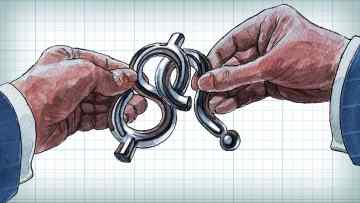
Third - a more focussed version of question two: (I like this Russian doll structure) What does a government guarantee to national banks even mean in a currency union? The Irish government does not control the printing presses and so cannot print euros to re-fund depositors. Presumably, they would have to sell Irish government bonds. Easy enough for them, perhaps, given low levels of government debt. But let’s see the Italians try the same trick.

Back to Gideon Rachman
This blog covers a variety of topics from US foreign policy to European politics and the Middle East - and whatever else happens to be in the news or catch my attention. I joined the FT as chief foreign affairs commentator in 2006, after a 15-year career at The Economist which included stints as a correspondent in Brussels, Bangkok and Washington. I write a weekly column on foreign affairs, which appears in the paper on Tuesdays. Occasionally my FT colleagues contribute posts to this blog.
Geoff Dyer is the FT's China bureau chief. He has been a correspondent in Shanghai and in Brazil and has also covered the pharmaceuticals and biotechnology industries from London.
Roula Khalaf is the FT's Middle East editor. She has worked for the FT since 1995, first as North Africa correspondent, then Middle East correspondent and most recently as Middle East editor. Before joining the FT, she was a staff writer for Forbes magazine in New York.
James Blitz is the FT's defence and diplomatic editor. He has been the FT's political editor, based in London, and Rome bureau chief. James is a former Moscow bureau chief for the Sunday Times.
Alan Beattie is the FT's world trade editor. He has previously been economics leader writer and spent two years in Washington DC as chief US economics correspondent. Before joining the FT, Alan was an economist at the Bank of England.
Victor Mallet is the FT's Madrid bureau chief. He is a former Asia editor of the FT, and, in more than 20 years at the organisation, has also worked in Africa, Europe and the Middle East. In 1990 he escaped from Kuwait after being one of the few foreign correspondents there when Iraq invaded.
Stefan Wagstyl is the FT's eastern Europe editor, co-ordinating coverage of the region. He has also been the FT's bureau chief in Tokyo and New Delhi.