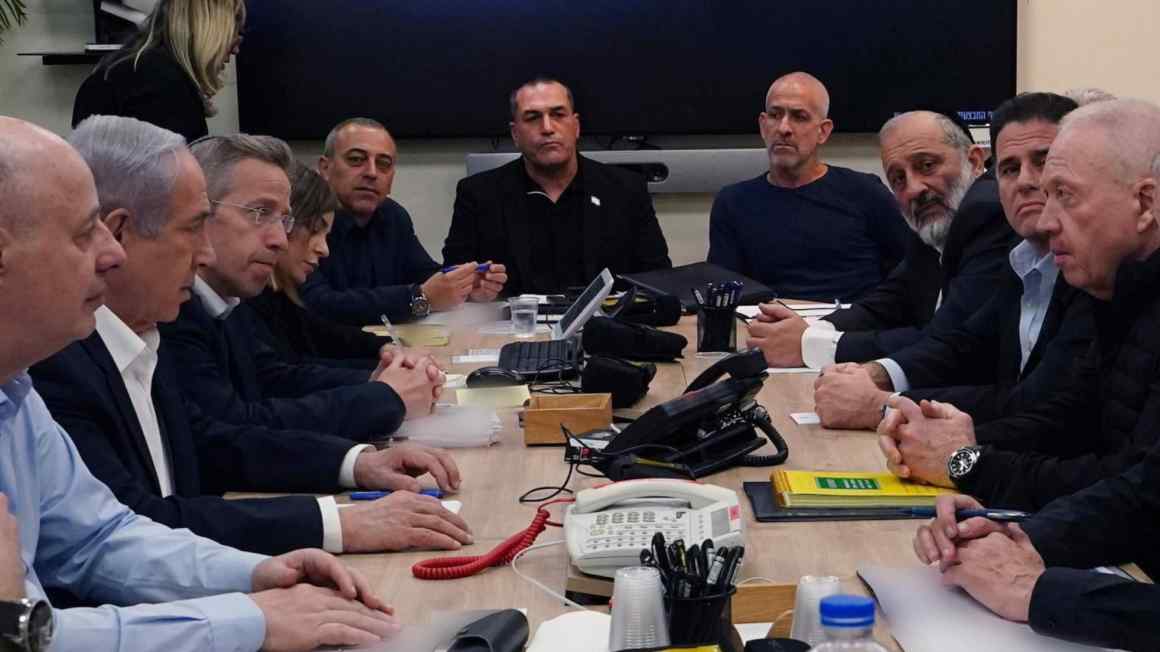
I am in Israel this evening. Election posters are everywhere and there is lots of excitement ahead of the vote on Tuesday. But visiting Hebron market on the West Bank this afternoon, I didn’t find any Palestinians who seemed to think the result would make much difference to them.
Even though the Palestinians are studiously indifferent to the Israeli elections, their own politics are on the move. Hamas have always been strong in Hebron - and the general opinion seemed to be that the war in Gaza had strengthened support for them in the West Bank as well. One woman trader I spoke to didn’t seem too happy about it. “If Hamas take power in the West Bank”, she said, “it will be very bad for women. They will make me close my stall down.”
I’ve never seen anywhere on the West Bank where Israeli settlers and Palestinians live so close together as in Hebron. The town is now effectively divided by check-points, walls and metal gates - all policed by a very heavy Israeli military presence. The Israeli side seemed comatose this afternoon, a combination of the fact that it was the Sabbath and that there are only 400 settlers, guarded by hundreds more troops. I saw one extravagantly bearded man out for a stroll with his family - a charming scene, apart from the fact that he had a machine-gun strapped across his chest.
The Palestinian side was thronged with people. But bustling would be the wrong word. Trade in the market is very slow. Traders lamented that tourists are now too scared to come to Hebron, after the war in Gaza. The economy is bad, the settlers are intimidating - and then these is the Chinese problem. One man attempting to sell me a Palestinian headscarf said proudly that it was made right nearby, in the West Bank. Apparently, most Palestinian handicrafts in the market are now, in fact, made in China. Local manufacturers are suffering.
Hebron doesn’t feel like the kind of place anybody would choose to live, unless they were a religious fanatic - or had no option. But one Palestinian trader revealed that he had lived for several years in Manchester in the 1980s. He had returned to the West Bank because he couldn’t stand the weather and the food - “chips, sausages and everything covered in vinegar.” I tried to tell him that things had changed in Manchester and you can now get a decent meal. But he didnt seem convinced.

Back to Gideon Rachman
This blog covers a variety of topics from US foreign policy to European politics and the Middle East - and whatever else happens to be in the news or catch my attention. I joined the FT as chief foreign affairs commentator in 2006, after a 15-year career at The Economist which included stints as a correspondent in Brussels, Bangkok and Washington. I write a weekly column on foreign affairs, which appears in the paper on Tuesdays. Occasionally my FT colleagues contribute posts to this blog.
Geoff Dyer is the FT's China bureau chief. He has been a correspondent in Shanghai and in Brazil and has also covered the pharmaceuticals and biotechnology industries from London.
Roula Khalaf is the FT's Middle East editor. She has worked for the FT since 1995, first as North Africa correspondent, then Middle East correspondent and most recently as Middle East editor. Before joining the FT, she was a staff writer for Forbes magazine in New York.
James Blitz is the FT's defence and diplomatic editor. He has been the FT's political editor, based in London, and Rome bureau chief. James is a former Moscow bureau chief for the Sunday Times.
Alan Beattie is the FT's world trade editor. He has previously been economics leader writer and spent two years in Washington DC as chief US economics correspondent. Before joining the FT, Alan was an economist at the Bank of England.
Victor Mallet is the FT's Madrid bureau chief. He is a former Asia editor of the FT, and, in more than 20 years at the organisation, has also worked in Africa, Europe and the Middle East. In 1990 he escaped from Kuwait after being one of the few foreign correspondents there when Iraq invaded.
Stefan Wagstyl is the FT's eastern Europe editor, co-ordinating coverage of the region. He has also been the FT's bureau chief in Tokyo and New Delhi.