
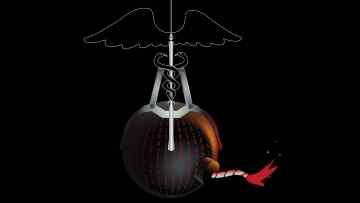


An additional 3,000 civilians will be axed from the Ministry of Defence after ministers realised the department’s “black hole” – the gap between revenue expectations and spending commitments – was bigger than previously thought.
This “black hole” has become one of the government’s most effective examples of Labour profligacy versus coalition (especially Conservative) fiscal discipline. But in truth, we’ve never really known how big it is or how close it is to being eliminated.
It is generally reckoned that when the coalition came in, there was a £10bn gap that needed closing over the course of the parliament, but the total overspend on existing projects could eventually be as high as £38bn.
Liam Fox told the FT last summer that he had all but eliminated the full £38bn, but today’s cuts undermine that – the job losses are supposed to save an extra £3bn over the course of eight years.
More significantly, there is evidence that the black hole was never as big as both Fox and his successor, Philip Hammond, have claimed.
There are two reasons why it was never really £38bn.
The first is that the spending commitments made to calculate it were not all firm commitments. Liam Fox admitted to the defence select committee last year that around £8bn or £9bn could be cut without cancelling any contracts. This is what he said:
Q 135 Chair: I am sorry, but how much of that £38 billion was contractually committed?
Fox: Offhand, I couldn’t give an actual figure, but I will get it for the Committee.
Q 136 Ms Stuart: Is it a third, a quarter, two-thirds?
Fox: There is a huge ability to reduce a very large proportion of that. My guess is that of that £38 billion we are talking of something like £8billion to £9 billion, and that is a ballpark figure.
Secondly, and more importantly, the £38bn figure comes only if there is no increase in the MoD budget at all over ten years – not even in line with inflation. The previous government said that if there was a 2.7 per cent annual rise in the budget each year it would be only £6bn.
In fact, there will be a 1.6 per cent rise in cash terms in the MoD budget, followed by a flat cash settlement from 2015-2020, but with a 1 per cent above-inflation rise in the equipment budget.
All this probably places the black hole somewhere between £6bn and £38bn, and definitely not at either end of the spectrum. Although it is worth pointing, as the National Audit Office did in their report of 2009:
In either case the budget remains consistently unaffordable over the next ten years.


Jim Pickard
Kiran Stacey