

This morning’s Labour press conference wrapped up with Gordon Brown gushing about how his wife Sarah was the love of his life:
Lord Mandelson did not seem overwhelmingly enthused.
His response: “Isn’t that lovely? Goodbye.”
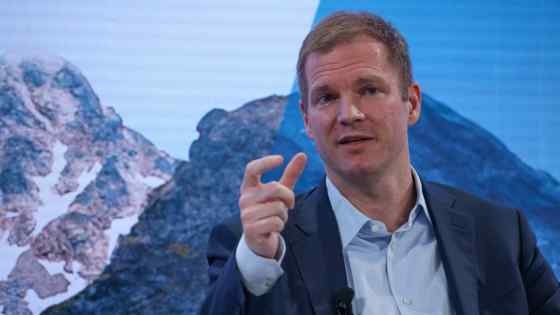
Unless you read the financial pages you may not be aware of Corporate Britain’s latest eye-catching payout: a £92m remuneration package for Bert Becht (not to be confused with Bertold Brecht). He is the chief executive of Reckitt Beneckiser, which makes products such as Vanish and Dettol.
To be fair, Becht has set up a charitable foundation to which he has given more than £100m. Even so; isn’t there an issue with this kind of payout just months after the credit crunch?
Vince Cable told me last night this was “extraordinary” and “unbelievable” and showed the often painful differential between the highest and lowest-paid workers.
David Cameron’s Tories seem to have acquired a taste for tax-cutting after the apparent success of last week’s National Insurance pledge.
During intense negotiations between the Tories and Labour this evening (over the “wash-up” of Parliamentary business – horsetrading to see which bills will make it on to the statute book) the latter have been forced to drop three tax rises which were in the Budget.
I heard several weeks ago that some Labour figures were pushing for a new “living wage” in the manifesto – perhaps of £7.60 an hour – which would apply to people in London. There the minimum wage is often seen as insufficient to get by.
I didn’t believe it would happen: would the likes of Lord Mandelson allow it; given the cost implications for employers of all stripes? (The current minimum wage is £5.80 an hour). And I’m still very suspicious.
In a sense Labour has been hoist by its own petard: in 1997 it secured a letter signed by numerous eminent businessmen praising its policies – and thus underlining its electability.
Now, a similar letter from 23 leading company executives threatens to do the exact reverse by criticising Labour policy just weeks before the general election. Executives from industry and the City like to back winners. (And while some of these are Tory donors, most are not).
This time the executives are backing the Conservative plan to partially reverse next year’s National Insurance increase, at the cost of about £5bn (found through efficiency savings across Whitehall).
At first glance the letter does appear to be a bombshell – and has certainly been written up in this way across the media. As George Osborne said: “This is proving to be a significant day. Gordon Brown now finds himself at war with business.”
But don’t be fooled, however, by any suggestion that the letter, now backed by the CBI, Institute of Directors, and British Chamber of Commerce, is not born of self-interest.
It’s been through more changes than a Lady Gaga set, or so it seems. But the reform of the MPs’ allowance system has now reached an end.
The biggest news from this morning’s press conference:
MPs will be allowed to employ their spouses – after earlier indications that this would be banned. You may remember that it was the Derek Conway scandal (his son wasn’t working desperately hard in the Commons) that sparked the entire expenses furore.
However, MP’s will be restricted to hiring only one significant other, or “connected party” (whether sibling, daughter, son, wife, girlfriend, husband, boyfriend, mistress, etc).
This is despite 59 per cent of respondents wanting the practice banned – and only 22 per cent putting the opposite view. Sir Ian responded by saying that his committee’s job was to “weigh up” the counter-arguments rather than simply instate the public view.
Why the fudged compromise? The best question of the day goes to Rosa Prince at the Telegraph, who asked why – if it was okay to hire one family member – it wasn’t okay to hire several.
I’m not sure Sir Ian answered it properly.
Other news from this morning:
Clearly the Conservatives felt the need for a new, more positive policy and have come up with the old Tory favourite: a tax cut. George Osborne has just spelled out a pledge to partially reverse a 1 per cent rise in national insurance due to take place in one year’s time. It is likely to be welcomed by some business groups.
The extra billions of cost will supposedly come from cuts in public spending, largely through efficiency savings. (Osborne talked about cutting property costs, reducing IT projects and not filling vacant back office posts).
But the policy places big question marks under the Tory pledge to go “further and faster” than Labour in cutting the £167bn deficit.
Most striking is Osborne’s acceptance of the £11bn of “wasteful expenditure” identified in last week’s Budget which could supposedly be cut from Whitehall departments. This included some highly dubious figures such as £550m from reducing staff sick leave from the NHS. Just like that.
The Tories are taking this £11bn figure for granted and then adding billions more of their own “savings”.
The announcement follows Saturday’s news story about how the Tories would ring-fence benefits for pensioners including the winter fuel allowance.
Anyone hoping for extra clarity over the details of just how the next government – of any colour – will cut public debt looks increasingly likely to be left disappointed.
UPDATE
Here is a link to Jean Eaglesham’s news coverage of the event.
Alex and I share an office with George Parker, the FT’s political editor, and Jean Eaglesham, FT chief political correspondent.
I’ve just carried out an impromptu stock-take of the fridge:
A bottle of gin*, two bottles of white wine (one Muscadet, one Blossom Hill) ,a box of cigars (courtesy of Jimmy Burns), no fewer than 19 Mars Bars and a solitary apple. Should I be concerned?
UPDATE
Alex points out there is also a carton of rotten milk.
* Unopened, I hasten to add…a gift from the Drinkers’ Alliance who were campaigning against a punitive rise on spirits/wine in the Budget. Personally I’m more of a White Ace drinker – which alas I now have to call ‘made wine’ rather than cider…..
I’ve just had a freedom of information request back from the Cabinet Office giving me the dates of Tony Blair’s visits to Downing Street since he quit in June 2007.
It confirms the idea of him dropping in on occasions but not very frequently:
July 27, 2007…September 17, 2007…June 15, 2008…May 21, 2009…September 18, 2009
The FOI says that Blair came to Downing Street to discuss the Middle East in his role as peace envoy there. Hard to believe that this is all they talked about though.
Some of the discussions I was already aware of from Labour sources:
Blair gave his successor advice during the expenses crisis last May. He also talked to Brown ahead of the G20 talks in the US in late September. As for the other three though; I’ve no idea what they were all about. You’re welcome to make any suggestions as to what was going on during these dates (a feeble attempt to crowdsource this blog’s readership).
UPDATE
The Cabinet Office has also come back to say it can’t comment on any details of Alastair Campbell’s recent visits to Downing Street. FOI only “applies to information held for official purposes,” it points out.
Does that mean that any informal visits by Blair would not be registered – in which case he could have been there more frequently?
It’s just that I tried the site second ago.
And it had this response:
If it’s a cyber-failure – too early to tell right now – it would be immensely embarrassing for the party.
UPDATE
It turns out that if you type in
http://www.yourbudgetresponse.co.uk
rather than
http://www.yourbudgetresponse.com
it works…mysterious….
FURTHER UPDATE
The Conservatives are admitting that the site wasn’t up and running until after 3.30pm. They say that they had to wait for the Treasury to publish an online document with the full Budget. (The site was also jammed with traffic). That document then had to be converted into a different file. So there you go.
Is it morally right to bribe voters into taking a huge leveraged bet on an asset class which is overvalued?
That will be the question if Alistair Darling, as rumoured this morning, introduces a stamp duty exemption on houses up to £250,000.
The policy may be a vote winner in Middle England; presumably that is its intention. It’s also no co-incidence that it has been Tory policy since 2007.
But bear in mind that house prices, after a dip in 2009, are now once again close to their pre-credit crunch highs.
This is not due to any obvious reason other than the fact that the Bank of England interest rate has been at an artificially low level to stave off depression. When it goes back up again – from its current 0.5 per cent – so to will mortgage costs. At that point house prices are likely to fall.
Ken Clarke, to his credit, made this very point a few says ago, advising people not to buy a house unless they could handle an interest rate spike.
Labour, cynically, appear to be doing the complete opposite.
UPDATE
One of my contacts suggests that the announcement could have a sting in the tail: what if they also introduce a new, higher band for stamp duty: or increase the existing higher band from 4 per cent to 5 per cent? This would certainly counter the charge that this is an unfunded handout – of the kind which Darling had promised not to deliver.
To what extent was Stephen Byers exaggerating or even fantasising when he claimed that he was able to influence the process by which National Express exited a loss-making East coast rail franchise?
That is certainly the current view of Byers himself, who – perhaps after realising he had been the victim of a journalistic sting – retracted his claims. Hilariously, he has “regretted that my misleading comments might be taken seriously”.
Originally Byers, a former transport secretary (the picture is old but I love the moustache) told the fake lobbyist that he had enabled National Express to negotiate favourable terms in jettisoning the franchise without penalties.
The problem with his self-promoting claim is that the contract ended last year with the loss of £72m to the transport company, in the form of a £32m performance bond and a £40m loan which it walked away from.
| About this blog | Blog guide |